Showing posts with label Scripture. Show all posts

Saturday, August 28, 2021

The Generous Hermeneutic of Augustine of Hippo

(Relief from the pulpit of the Cathedral of St. Paul, Fond du Lac, Wisconsin)

In an essay on Augustine’s Biblical Interpretation, The Rev. Dr. Thomas Williams shows that the great saint and theologian was willing to allow that there might be more than one true understanding and that the biblical author’s intended meaning might not be the only true one:

Suppose, then, that Augustine says Genesis 1:1 means x, and I say it means y; suppose further that upon consulting Christ as Inner Teacher we find that both x and y are true. The only question is, which did Moses mean, x or y? Augustine asks, why not both?

So when one person says “He meant what I say,” and another says “No, he meant what I say,” I think it would be more pious to say “Why not both, if both are true?” And if someone should see in his words a third truth, or a fourth, or indeed any other truth, why not believe that Moses saw all these truths? (Confessions 12.31.42)

Somewhat surprisingly, it is not pride but just good Augustinian theology (and epistemology) to suspect that we might find truths in Moses’ writings that had never crossed his mind:

Finally, Lord, you who are God and not flesh and blood, even if one who was merely a man did not see all there was to be seen, did not your good Spirit, who will lead me into the land of uprightness, know everything that you would reveal through these words to later readers, even if the one who uttered them was perhaps thinking of only one of the many true meanings? If so, let us suppose he was thinking of whichever meaning is most exalted. O Lord, show us that meaning; or if you please, show us some other true meaning. In this way, whether you show us just what you showed your servant, or something else that emerges from the same words, we will in any event be fed by you, not mocked by error (Conf. 12.32.43).6

[Augustine is able to be generous in allowing more than one true interpretation because of what he understands the purpose of scripture to be. Professor Williams continues with reference to Augustine’s De Doctrina Christiana (On Christian Teaching)]:

The pursuit of knowledge for its own sake is bankrupt, as far as Augustine is concerned. Such a pursuit springs from curiosity, which for him is no admirable trait but a vice; he identifies it with that “lust of the eyes” of which John wrote, “For all that is in the world—the lust of the eyes, the lust of the flesh, and the pride of life—is not of the Father but is of the world” (1 John 2:16). So it is not surprising that when Augustine discusses the legitimacy of rival interpretations of Scripture, he reveals a deep concern with the morality of exegetical disputes. Undue attachment to one’s own exegesis manifests a sort of pride, the love of one’s own opinion simply because it is one’s own opinion. In Confessions 10 Augustine describes this as a form of the “pride of life,” the third of the unholy trinity of sins from 1 John 2:16. It is more grievous still when the exegete is driven by the desire for a reputation as a brilliant scholar; “this is a miserable life and revolting ostentation” (Conf. 10.36.59). Moreover, since truth is common property, one’s own opinion is not really one’s own at all if it is true; it is the common property of all rightthinking people, and no one has any individual stake in it: No one should regard anything as his own, except perhaps a lie, since all truth is from him who says, I am the truth’” (doctr. chr. Prologue, 8). Also, only temerity and insolence could justify such confidence in something we cannot actually know. We can know what Truth itself says, but we cannot know with any degree of certainty what Moses or Paul was thinking when he wrote the biblical text we are expounding. Most important of all, charity demands that we abstain from all such “pernicious disputes.”

For charity is the ultimate aim of all worthy exegesis. “Whoever thinks he has understood the divine Scriptures or any part of them in such a way that his understanding does not build up the twin love of God and neighbor has not yet understood them at all” (doctr. chr. 1.36.40). Charity is, moreover, the unifying and animating theme of Augustine’s treatise on biblical interpretation, De doctrina Christiana (On Christian Teaching). Its message is this: Be always mindful of the end, and be on your guard against the pernicious tendency of means to encroach upon the ends. The end of all things, Augustine insists, is God. He alone is to be loved for his own sake—“enjoyed,” in Augustine’s terminology. Whatever else is to be loved should be “used,” that is, loved for the sake of God. Even human beings, including ourselves, should be “used” in this sense, which does not mean “exploited.” But Augustine cannot quite bring himself to talk consistently of “using” ourselves and our fellow human beings, and he defines charity as “the motion of the soul toward enjoying God for his own sake and oneself and one’s neighbor for God’s sake” (doctr. chr. 3.10.16). Its opposite, cupidity, is “the motion of the soul toward enjoying oneself, one’s neighbor, or any bodily thing for the sake of something other than God” (Ibid.). Scripture, Augustine says, “commands nothing but charity and condemns nothing but cupidity [inordinate desire]” (doctr. chr. 3.10.15).

Interest in Biblical interpretation for its own sake is one such form of cupidity; exegesis is to be used for the sake of charity, not enjoyed for its own sake. In Augustine’s metaphor, it is not the distant land where we will be happy, but merely a vehicle by which we may be conveyed there.

The fulfillment and end of the Law and of all divine Scripture is the love of a being that is to be enjoyed [i.e., God], and of a being that can share that enjoyment with us [i.e., our neighbor]. . . . That we might know this and be able to achieve it, the whole temporal dispensation was made by divine providence for our salvation. We should use it not with an abiding but with a transitory love and delight like that in a road or conveyances or any other means. . . . We should love those things by which we are carried for the sake of that towards which we are carried (doctr. chr. 1.35.39; see also 1.4.4).

So overriding is this end that even misreadings of Scripture are scarcely objectionable if they build up charity. Someone guilty of such a misreading is to be corrected only on pragmatic grounds, not in the interest of scholarly correctness (an ideal to which Augustine shows not the slightest allegiance):

He is deceived in the same way as someone who leaves a road by mistake but nonetheless goes on through a field to the same place to which the road leads. Still, he should be corrected and shown how much more useful it is not to leave the road, lest his habit of wandering off should force him to take the long way around, or the wrong way altogether (doctr. chr. 1.36.41).


See also:

Some Thoughts on Interpreting Scripture

Faith and Love are Always to be Mistresses of the Law


Friday, August 28, 2015

How I Came to Change My Mind on SSU: Part 6. Back to the Bible


Last May I began a series of blog posts “How I Came to Change My Mind on Same Sex Unions.” For a variety of reasons, I set that series aside for much of the summer. I am now resuming that series.

To recap, I began expressing some of the obstacles to my change of mind.

I then explained that it was the testimony of brother and sister Christians who are gay and lesbian that prepared me to rethink things. I wrote about the negative testimony by gay and lesbian Christians of the toll the traditional understanding has often had on them and about the positive testimony of the faithful lives of gay and lesbian Christians.

I also jumped ahead, given the approach of the General Convention of the Episcopal Church, and expressed my view that same sex unions might not be exactly the same thing as marriage between a man and a woman.

And I wrote some thoughts on interpreting scripture in which I proposed what I think is a biblical way of reading the Bible which makes the love and mercy embodied and taught by Jesus the measure of interpretation. Thus it is faithful to seek an interpretation of scripture that is the most merciful and that leads us deeper into love. And I showed that this is not a new idea, but has precedent elsewhere among important Christian theologians.

That is where I stopped. I still haven’t looked at the particular passages of the Bible that commonly come into play when Christians engage questions raised by the reality homosexuality. In coming posts, i will be reviewing that much traveled territory. I don't know that I have much that is new to add, but I will offer interpretations that I find persuasive. But, before I do that, I want to say a bit more about my approach to the Bible.

Getting Biblical

In a recent post not linked to this series, I referred to a study guide on understanding and interpreting the Bible: The King or a Fox: Configuring the Mosaic of Scripture. In that study guide I point out that there is no one official, God-given way of understanding of what it means for the Bible to be inspired or how to interpret it. And I acknowledge that faithful Christians have come to different conclusions interpreting the Bible on significant issues (I offered more examples of this in the introduction to another study guide, In Dialogue With Each Other). I then offered some criteria for discerning more faithful from less faithful interpretations of scripture.

Illustrating the reality that faithful Christians have embraced very different approaches to the Bible, I recently posted a few quotes from Martin Luther whose approach to the Bible was very different from that of many contemporary American Christians. It is also a fact that the approaches to the Bible embraced by most American Christians, including conservative Christians, are actually quite recent inventions.

I am reviewing these, because I want to acknowledge that I am advocating a particular approach to the Bible. It is not the only approach. But, as I said, I think is a biblical way of reading the Bible which makes the love and mercy embodied and taught by Jesus the measure of interpretation. Thus it is faithful to seek an interpretation scripture the most merciful and that leads us deeper into love. This is not a new idea or a "liberal" idea, but has precedent elsewhere among important Christian theologians from the early church through the Reformation.

I am advocating a Christ-centered approach to the Bible because I believe

Long ago God spoke to our ancestors in many and various ways by the prophets, but in these last days he has spoken to us by a Son, whom he appointed heir of all things, through whom he also created the worlds. He is the reflection of God’s glory and the exact imprint of God’s very being, and he sustains all things by his powerful word. When he had made purification for sins, he sat down at the right hand of the Majesty on high, having become as much superior to angels as the name he has inherited is more excellent than theirs. (Hebrews 1:1-4)

There is much we do not understand about the Bible or life in general,

but we do see Jesus, who for a little while was made lower than the angels, now crowned with glory and honor because of the suffering of death, so that by the grace of God he might taste death for everyone. (Hebrews 2:9)

It is Jesus who is the Word of God (John 1:1-18). The Bible is the word of God inasmuch as it points us to and reveals Jesus. It points to the way, the truth, and the life that Jesus is. So, in the next post I will begin with Jesus.


Part 1. Obstacles


Monday, August 17, 2015

The King or a Fox: Configuring the Mosaic of Scripture


Last spring, on the website of the Diocese of Fond du Lac, I offered a study guide to understanding and interpreting Scripture  The King or a Fox: Configuring the Mosaic of Scripture. I used an image proposed by the great 2nd century theologian, Irenaeus of Lyon who argued that reading scripture is like configuring a mosaic of precious jewels. That mosaic can be configured in more ways than one.The trick is discerning faithful from unfaithful configurations while recognizing the fact that faithful interpreters of the Bible do not always come at it the same way or come to the same conclusions.

In that study, I briefly explore ways of understanding what it means for the Bible to be inspired and suggested a way of thinking about the purpose of scripture.

The main purpose of scripture is to show us who Jesus is, who God is in light of Jesus, and who we are and who we can be when we are properly aligned with God in Christ through the Holy Spirit. It is about shaping our lives and imaginations. It places demands upon us, but it also opens up visions and possibilities for ourselves and our world that we could scarcely imagine otherwise.

I then proposed ten criteria for faithful interpretation/configuaration of the Bible. Here are those criteria with condensed explanations:

There is a basic outline that informs any faithful configuration of scripture. That is the story of God’s creating the world and declaring it good, the recognition that that goodness has been despoiled rather than lived into, God’s call of Abraham and his descendants to be a blessing to the nations, the deliverance of God’s people in their exodus from evil, the establishing of the royal line of David, their return from exile, the growing expectation of God’s restoration of all things, Jesus Christ as the embodiment and fulfillment of that expectation, and the Church as the community called to bear witness to and live into that expectation.

Beyond that basic outline, what might be some criteria to help us configure scripture such that we are more likely to end up with a portrait of the King rather than a fox while recognizing the complex ways in which we all make interpretive choices and give some portions of scripture priority over others? How do we recognize the King in a configuration of scripture while still accounting for the reality that we do not always end in the same place and not all faithful portraits will look exactly the same? Can we identify some criteria or criteria by which we evaluate more faithful biblical configurations from less faithful or even faithless interpretations? Not all configurations are faithful. Not all faithful configurations are equally faithful. But there might be a range of recognizably, more or less, faithful configurations. The following criteria, based on how the canon of scripture came to be accepted and how the early church read the Bible, are suggested to assist in configuring the mosaic of scripture o we see a faithful portrait of the King.

1. The Criterion of Jesus Christ

While any faithful interpretation must take into account the whole witness of scripture, Old Testament and New Testament, Jesus Christ is the center and measure of all things including the rest of Scripture (Hebrews 1:1-2).

2. The Criterion of Love

Interpretations of scripture that cultivate mercy and charity are preferred.
Jesus asserts this in Matthew 22:40, “On these two commandments [love of God and neighbor] hang all the law and the prophets [all of scripture]. It is also implied in Jesus’ teaching in Mark 2:27, “The Sabbath [symbolic of the law] was made for humans, not humans for the Sabbath.”

3. The Criterion of the Rule of Faith

One of the important criteria the early Church used in discerning which writings to recognize as canonical was whether they conformed to the Rule of Faith – the teaching passed down from the Apostles. That Rule of Faith finds its expression for us in the Creeds.

4. The Criterion of the Church’s Prayer

The rule of prayer is the rule of belief (Lex orandi, lex credendi). We believe what we pray. As with the Rule of Faith, there is a symbiotic relationship between the Church’s worship and its reading of scripture.

5. The Criterion of the Church's Tradition

We always read the Bible with the saints. The wisdom of the Communion of the Saints is a gift that shapes our ongoing configuration of scripture. For Anglicans, this has classically meant especially the catholic consensus that developed in the first five centuries.

6. The Criterion of Comprehensiveness

The scriptures contain multiple concerns, themes and images, many of which are in apparent tension with others. They are not given to neat systematization. Any comprehensive approach to the Bible ends up with some anomalies.

The fewer passages of scripture that are anomalous to a configuration the better. Even then, the remainder remains and must be acknowledged and reckoned with.

7. The Criterion of Dissimilarity

While it is incumbent upon Christians of every time and place to interpret scripture afresh in light of their context, any faithful reading of scripture must be dissimilar enough from the surrounding culture and the interpreter's social/intellectual milieu to maintain the edge of repentance and conversion.

8. The Criterion of the Book of Nature/Creation

Theologians of the early and Medieval Church frequently refer to creation as God’s other “book” of revelation. A faithful configuration of scripture will take into account what we know of creation as it is.

9. The Criterion of Community

The God revealed in the scriptures calls people into community and it is to the community that they are addressed with the intention of forming and sustaining a people of witness. Scripture is about the Church. It has its fullest meaning in the context of the Church and its worship. It describes the God who has called us and made us a people who were not a people and describes what kind of people we are to be in response.

10. The Criterion of Character

The scriptures are about the formation of holy communities and holy persons as members of such communities. There is a symbiotic relationship between the scriptures forming holiness and the necessity of a degree of holy living in order to understand the scriptures.

Conclusion

No one criterion is adequate and no set of criteria will assure agreement on particular questions of interpretation. And some of the above criteria will sometimes seem to be in tension with one another. They are not a formula to insure that we all find one supposed true interpretation – we will always be living under the mercy of God. But, an interplay of the above criteria would provide a broad measure of relative faithfulness as we seek together to configure an image of the King rather than a fox and to allow our lives to be shaped in his image.

Thursday, August 13, 2015

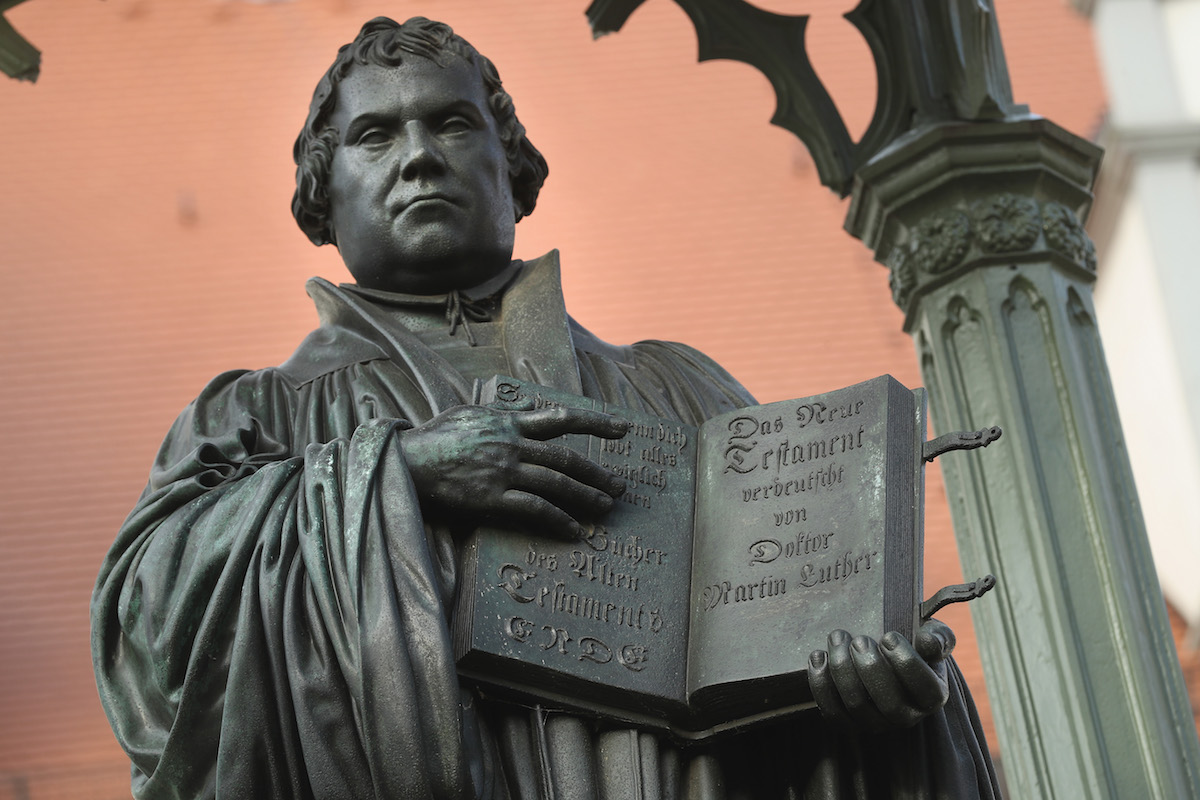
Martin Luther on the New Testament

The last two posts have been excerpts from Martin Luther’s introduction to the Old Testament. In one of those excerpts, the great reformer asserts that the Old Testament is analogous to the manger and swaddling-clothes in which Jesus is laid, suggesting that not that is contained in the Old Testament is to be equated with Jesus Christ. In the other he insists that “all laws aim at faithand love, none of them can be valid, or be a law, if it conflicts with faith and love.”

Here are the last few paragraphs of Luther’s Preface to his German translation of the New Testament (1522):

Which are the true and noblest books of the New Testament?

From all this you can now judge all the books and decide among them which are the best.  John’s gospel and St. Paul’s epistles, especially that to the Romans, and St. Peter’s first epistle are the true kernel and marrow of all the books. They ought properly to be the foremost books, and it would be advisable for every Christian to read them first and most, and by daily reading to make them as much his own as his daily bread. For in them you do not find many works and miracles of Christ described, but you do find depicted in masterly fashion how faith in Christ overcomes sin, death, and hell, and gives life, righteousness, and salvation. This is the real nature of the gospel, as you have heard.

If I had to do without one of the other – either the works or the preaching of Christ – I would rather do without the works than without His preaching. For the works do not help me, but His words give life, as He Himself says [John 6:63] . Now John writes very little about the works of Christ, but very much about His preaching, while the other evangelists write much about His works and little about His preaching. Therefore John’s Gospel is the one, fine, true, and chief gospel, and is far, far to be preferred over the other three and placed high above them. So, too, the epistles of St. Paul and St. Peter far surpass the other three Gospels, Matthew, Mark, and Luke.

In a word St. John’s Gospel and his first epistle, St. Paul’s epistles, especially Romans, Galatians, and Ephesians, and St. Peter’s first epistle are the books that show you Christ and teach you all that is necessary and salvatory for you to know, even if you were never to see or hear any other book or doctrine. Therefore St. James’ epistle is really an epistle of straw, compared to these others, for it has nothing of the nature of the gospel about it.
(The Protestant Reformation, Hans J. Hillerbrand, ed., New York, Harper Torchbooks, 1968, p. 42)

I am sympathetic to Luther’s approach to scripture. It is quite different from the approach I was taught growing up, i.e., that all of the Bible (except, of course, the Apocrypha), every word and verse, is equal in inspiration and authority.  But, my experience is that one way or another all readers of scripture give priority to some scriptural texts or themes by which the rest are measured. Luther was just more up front about it.

While I am sympathetic, I am less reductionist than Luther – at least as he is in the passage above. I would insist for example that the Gospel of John must not be read apart from the other three gospels. And I think the Epistle of James has much to teach us not least because the faith vs works dichotomy as Luther presents it is too simplistic and does not adequately reflect what Jesus taught or, for that matter, what Paul taught.

In any event, Luther’s introductions to the Old and New Testaments present an approach to the Bible quite different from what is common among many contemporary American Christians. Luther could be wrong. From the beginning of the Reformation (and before, actually) there has been more than one way to come at the Bible and understand its inspiration, authority and interpretation. No way of engaging the Bible dropped from the sky. And whether you were taught or consciously adopted a way of reading the Bible inherited from Martin Luther, John Calvin, Menno Simons, Thomas Aquinas, John Darby or someone else, it is not the only or obvious or authoritative approach. You either chose it or it was chosen for you by those who taught you. 

I have suggested an approach that I think is a faithful way of engaging the Bible here: The King or a Fox? Configuring the Mosaic of Scripture. And similar to Luther’s emphasis on faith and love, I have argued that a biblical way of reading the Bible will use love and mercy as Jesus taught and embodied them as the measure by which to interpret the Bible.

Previous:


Wednesday, August 12, 2015

Faith and Love are Always to be Mistresses of the Law

Following up on the last post, here is more from Martin Luther's introduction to the Old Testament:

[I]t is to be noted that the laws are of three kinds. Some speak only of temporal things, as do our imperial laws. These are established by God chiefly because of the wicked, that they may not do worse things. Such laws are for prevention rather than for instruction; as when Moses commands to dismiss a wife with a letter of separation, or that a husband shall bring an “offering of jealousy” for his wife, and may take other wives besides.

All these are temporal laws. — There are some, however, that teach the external worship of God, as was said above.

Over and above these are the laws about faith and love, so that all other laws must and ought to be measured by the laws of faith and love; that is to say, they are to be kept where their observance does not conflict with faith and love; but where they conflict with faith and love, they are entirely void.

Therefore we read that David did not kill the murderer Joab, though he had twice deserved death; and in 2 Samuel 14:11 he promises the woman of Tekoa that her son shall not die, though he has slain his brother; Absalom, too, he did not kill. Moreover, David himself ate of the holy bread of the priests, and Tamar thought the king might give her in marriage to her stepbrother, Amnon. From these and similar stories one sees plainly that the kings, priests, and heads of the people often transgressed the laws boldly, at the demand of faith and love, and therefore that faith and love are always to be mistresses of the law and to have all laws in their power. For since all laws aim at faith and love, none of them can be valid, or be a law, if it conflicts with faith and love.

Tuesday, August 11, 2015

Martin Luther & Scripture as the Swaddling-clothes and the Manger in which Christ lies

Let’s be honest. The Old Testament – along with much that is beautiful, wonderful, evocative, and edifying – contains material that is puzzling, disturbing, and even morally offensive when measured against the life and teaching of Jesus. One of the big questions of biblical interpretation is how to make sense of that.

One way to at least begin answering that question is Martin Luther’s double analogy in his introduction to the Old Testament. First he suggests that the Old Testament is like a rich and inexhaustible mine in which we find the wisdom of God. Then he compares it to the manger and swaddling clothes in which Jesus lies. Not everything in the Old Testament is the treasure. Some of it is more swaddling clothes and manger. But it is the loftiest and noblest of holy things because of the treasure it holds:

Therefore let your own thoughts and feelings go, and think of the Scriptures as the loftiest and noblest of holy things, as the richest of mines, which can never be worked out, so that you may find the wisdom of God that He lays before you in such foolish and simple guise, in order that He may quench all pride. Here you will find the swaddling-clothes and the manger in which Christ lies, and to which the angel points the shepherds.

Simple and little are the swaddling-clothes, but dear is the treasure, Christ, that lies in them.

More on Luther and scripture:


Tuesday, May 26, 2015

How I Came to Change My Mind on SSU: Part 4. Some Thoughts on Interpreting Scripture

When it comes to making Christian sense of the phenomena of same-sex sexual attraction, much depends on how we read scripture. But, that draws us into a much deeper and broader challenge in the contemporary church. There is a good deal of uncertainty across the church as to how best to engage the scriptures and a loss of confidence in some old assumptions about how to do so. One sign of this is the turn to early centuries of Church tradition for guidance among Evangelicals, something extremely rare until very recently.

Absent a Magisterium, as in the Roman Catholic Church, we are left to make sense of scripture in a context in which there is no straightforward, agreed upon, and authoritative hermeneutic (method of interpretation) for interpreting, understanding, or applying the writings we believe to be inspired by God and authoritative for the Church. The inevitable result is that faithful, pious Christians often come to different conclusions when interpreting the scriptures on a given matter. Even people who basically agree on the authority and inspiration of scripture and how it should be read often come to quite different conclusions on important issues.

We all need to give more attention to the interpretive principles by which we configure scripture such that some themes and passages are given more weight than others. And we all need to practice a good deal more charity and humility toward one another when we disagree.

Before looking at any particular passage of scripture that mentions same-sex sexual relations, it is important to look at what makes for faithful interpretations of scripture in general. I’ve attempted a constructive proposal for engaging scripture elsewhere (see The King or a Fox, a study guide for the Diocese of Fond du Lac in which I propose some criteria for interpreting scripture faithfully). Everything that follows should be understood in the context of that study guide. In this post I want to elaborate on one of the criteria I suggested for interpreting scripture – the Criterion of Love, which is closely related to another, the Criterion of Jesus Christ. Ultimately, this criterion by itself, like any one of the others, is insufficient and must be employed in harmony with the others. With those caveats, I do want to suggest that the criterion of love does open space for a rethinking of the meaning of the texts in the Bible that appear to address sex between people of the same gender.

St. Augustine on the double love of God and neighbor

St. Augustine, in his guide to interpreting scripture, argued that the fundamental key to faithful interpretation is Jesus’ summary of the law:

‘You shall love the Lord your God with all your heart, and with all your soul, and with all your mind.’ This is the greatest and first commandment. And a second is like it: ‘You shall love your neighbor as yourself.’  On these two commandments hang all the law and the prophets.
(Matthew 22:38-40)

It is to teach us how to do these two things rightly that we were given the scriptures in the first place. Augustine goes so far as to make this rather startling claim:

So anyone who thinks that he has understood the divine scriptures or any part of them, but cannot by his understanding build up this double love of God and neighbor, has not yet succeeded in understanding them. Anyone who derives from them an idea which is useful for supporting this love but fails to say what the author demonstrably meant in the passage has not made a fatal error, and certainly is not a liar. 
(On Christian Teaching [De Doctrina Christiana], English trans. R. P. H. Green (New York, Oxford University Press, 1997), 27)

Though this sounds remarkable, the idea that the building up of the double love of God and neighbor is the key for interpreting scripture is at least as well-founded in scripture as is Luther’s insistence that everything be interpreted through the lens of salvation by faith through grace. In fact, Luther, himself, asserted in his Introduction to the Old Testament that “faith and love are always to be mistresses of the law.” For more on Luther's interesting and nuanced approach to the Bible, see here and here.

Not only does Jesus give us the summary of the law, he applies it himself in a way that was shocking to his contemporaries when he insisted that “The Sabbath was made for humankind, and not humankind for the Sabbath.” (Mark 2:27). I submit that this was one of the most radical and unprecedented teachings of our Lord. The Sabbath – and the Law, generally? – is not something humans are meant to be squeezed into at any cost. Rather, it is given to us and for us to lead us into wholeness  life with God, others, and the rest of creation.

Paul makes several references to the centrality of Jesus’ summary of the law (cf. Romans 13:8-10, Galatians 5:13-14, Galatians 6:2), as do 1 John 3:23 & 4:21 and James 2:8. And the apostle seems to apply it as a key to discerning moral questions in his first letter to the church in Corinth:

“All things are lawful for me,” but not all things are beneficial. “All things are lawful for me," but I will not be dominated by anything.
(1 Corinthians 6:12)

“All things are lawful,” but not all things are beneficial. “All things are lawful,” but not all things build up.
(1 Corinthians 10:23)

Though Paul is reining in an apparent antinomian tendency among some of the congregation in Corinth, it is interesting that he does not do so with an appeal to the Law or some other abstract rule. Rather, he suggests measuring behaviors based on whether they exhibit self-control and the building up of the community.

It does not seem particularly revisionist” to agree with Augustine that interpretations that “build up this double love of God and neighbor” are to be preferred and that the test for whether or not an interpretation is in the ballpark of faithfulness is whether or not it can be demonstrated to do so. And if, as Jesus says, the Sabbath is made for humankind, not humankind for the Sabbath; might we entertain that if an interpretation of scripture seems to thwart the flourishing of members of the body of Christ that that interpretation needs to be looked at afresh? And if, as Paul says, the fundamental criteria on moral questions are what is beneficial for Christian freedom and the building up of the body of Christ and individual members of that body, might we ask in the case of Christians who are romantically and sexually attracted to members of the same sex, “What is beneficial? What enables them to not be dominated? What builds them up? Would the blessing of Same-sex Unions build up the church? Would such unions inherently get in the way of its being built up? Article XX of the Articles of Religion enjoins us not to “expound one place of Scripture, that it be repugnant to another.” Might we ask of any interpretation of scripture, “Is it repugnant to the double love of God and neighbor?

A way of self-denial

The double love of God and neighbor is not simple, sentimental, or easy. It requires self-denial. To love God requires us to know God – through the witness of the Bible, through worship and prayer, through the witness of tradition and the saints, and through the witness of creation. That also requires continual self-scrutiny lest we construct an image of God that suits us and then love the image we have formed for ourselves. To love our neighbor also requires that we actually come to know our neighbor. That too requires continual self-scrutiny to examine our own resistance to love and our tendency to project onto others what we already think they are or should be as characters of the story of our own making. The double love of God and neighbor requires taking up the cross and denying ourselves in order to be open to the Other (God) and the other (our neighbor).

A Roman Catholic principle of interpretation

Interestingly, the Roman Catholic Church has a similar principle of scriptural interpretation. The official teaching body of the Catholic Church, the Pontifical Biblical Commission, published a document, The Interpretation of the Bible in the Church (I recommend reading the whole thing). That document asserts, rightly in my estimation that the Scripture is always read in dialogue with subsequent generations:

Dialogue with Scripture in its entirety, which means dialogue with the understanding of the faith prevailing in earlier times, must be matched by a dialogue with the generation of today. Such dialogue will mean establishing a relationship of continuity. It will also involve acknowledging differences. Hence the interpretation of Scripture involves a work of sifting and setting aside; it stands in continuity with earlier exegetical traditions, many elements of which it preserves and makes its own; but in other matters it will go its own way, seeking to make further progress.
(III.A.3)

Part of that dialogue is “actualization”. To actualize Scripture means to bring the word of God into the present.

Already within the Bible itself . . . one can point to instances of actualization: very early texts have been reread in the light of new circumstances and applied to the contemporary situation of the people of God. The same basic conviction necessarily stimulates believing communities of today to continue the process of actualization.
(IV.A)

Actualization is necessary because,

although their message is of lasting value, the biblical texts have been composed with respect to circumstances of the past and in language conditioned by a variety of times and seasons. To reveal their significance for men and women of today, it is necessary to apply their message to contemporary circumstances and to express it in language adapted to the present time. This presupposes a hermeneutical endeavor, the aim of which is to go beyond the historical conditioning so as to determine the essential points of the message.
(IV.A.1)

But, not all actualization is faithful.

While every reading of the Bible is necessarily selective, care should be taken to avoid tendentious interpretations, that is, readings which, instead of being docile to the text make use of it only for their own narrow purposes (as is the case in the actualization practiced by certain sects, for example Jehovahs Witnesses).
(IV.A.3)

And some false paths” of actualizations are to be rejected because they are at odds with the basic gospel of Jesus Christ:

Clearly to be rejected also is every attempt at actualization set in a direction contrary to evangelical justice and charity, such as, for example, the use of the Bible to justify racial segregation, anti-Semitism or sexism whether on the part of men or of women. Particular attention is necessary... to avoid absolutely any actualization of certain texts of the New Testament which could provoke or reinforce unfavorable attitudes to the Jewish people.
(IV.A.3)

While there are plausible – maybe even probable – interpretations of scripture “contrary to evangelical justice and charity,” i.e., that endorse racism, antisemitism, sexism, slavery, etc., they are to be rejected. Interpretations that reflect and reinforce justice and charity are more faithful to the Good News of Jesus Christ. It seems to me that this principle makes space for asking whether or not we should be wary of reading biblical texts about homosexual behavior as referring in a straightforward way to what we are talking about now.

Of course, current official Roman Catholic teaching does not conclude from this that justice and charity rightly understood lead to the ordination of women or the blessing of Same-sex Unions. But, that merely raises the question of how we discern evangelical justice and charity and what “further progress in that direction might look like. In any event, as the Pontifical Commission, itself asserts,

[T]he risk of error does not constitute a valid objection against performing what is a necessary task: that of bringing the message of the Bible to the ears and hearts of people of our own time. (IV.A.3)

What it is and isnt about

The double love of God and neighbor is not about mere “inclusion which, in and of itself, is an empty concept. It is not merely a matter of declaring that “God loves everyone. Period. Few Christians would deny that. But it is an insufficiently Christian declaration. Gods love is not mere affirmation. It is transformative  sometimes uncomfortably so. Nor is it simply about “respecting the dignity of every human being. Of course we should live into that part of the Baptismal Covenant. But, respect and love do not mean affirming everything we want affirmed. Sometimes respect and love mean speaking hard truth in love (Ephesians 4:15). We must always be on guard against our inclination to rationalize our actions and call indulgence love. The Christian way of love is not sentimental or indulgent. It is self-sacrificial. Our love needs continually to be purified and transformed.

That said, given the centrality of love and mercy in our Lords teaching and the rest of the New Testament, we also need to beware that what we call love is recognizably love as opposed to a squeezing of others into abstract modes of being that neither build them up nor the Church. Love is not always nice. But it is always kind. Discerning the difference is one of the tasks of the Church living under the Mercy.

The issue, it seems to me, is whether or not entering into a committed, monogamous, permanent Same-sex Union provides a fertile context for the cultivation of redemptive, sanctifying disciplines that lead to deeper love of God and love of neighbor as exemplified by Jesus. It is about pursuing the holiness of God-centered, self-emptying, cross-bearing, other-oriented love incarnated by Jesus Christ and cultivating the disciplines that enable us to embody that love in thought, word, and deed. If this can be said of gay and lesbian Christians, might they also build up the community?

Next: Part 5. Why I Am Disinclined to Vote for Revising the Marriage Canon

Previous: Part 3. Positive Testimony